What Engineers Should Know Before Choosing an Industrial Locking Cylinder

In modern manufacturing, accurate positioning, secure workpiece holding, and consistent machine performance are essential for maintaining productivity and product quality. A reliable clamping cylinder helps hold components firmly during machining, assembly, welding, and other industrial operations. Selecting the right clamping and locking mechanism can improve operational safety, reduce workpiece movement, and support repeatable manufacturing results.
Dynamic Hydrofab (DHF) provides hydraulic cylinder solutions designed for industrial applications where controlled movement, dependable clamping, and reliable performance are important. Understanding the types, applications, and selection criteria of these components helps businesses make informed equipment decisions.

What Is a Clamping and Locking Cylinder?
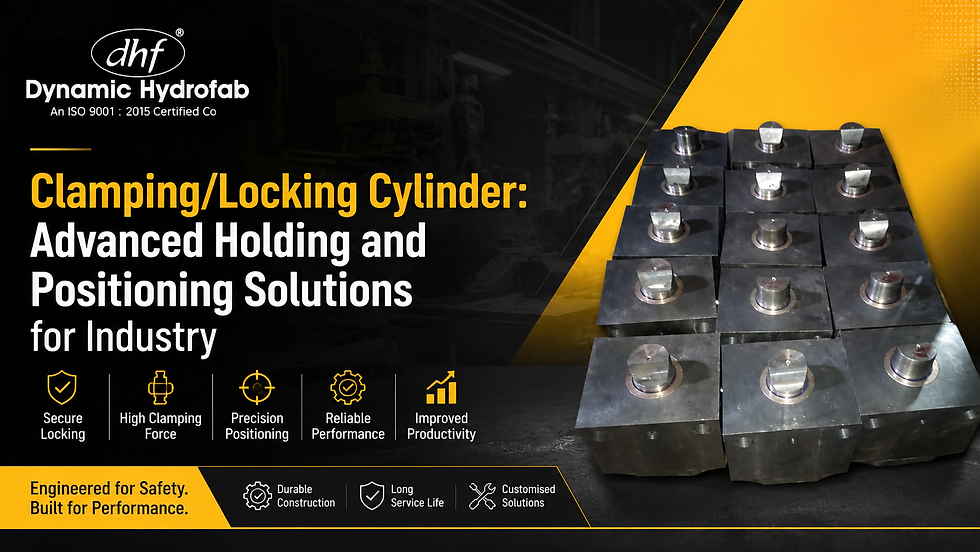
A clamping cylinder is an actuator used to apply force and hold a workpiece or machine component in a fixed position. It is commonly integrated into fixtures, automated production lines, machining systems, and specialized industrial equipment.
A hydraulic clamping cylinder uses pressurized hydraulic fluid to generate force, making it suitable for applications that require substantial clamping capacity and controlled operation. A locking cylinder may incorporate a mechanical or hydraulic locking arrangement to help maintain a position, depending on its design.
A locking hydraulic cylinder can be particularly useful in systems where controlled movement and position retention are essential. However, the appropriate locking mechanism depends on the load, operating pressure, installation arrangement, and required safety provisions.
Key Benefits of Industrial Clamping Cylinders
Choosing a suitable clamping solution offers several advantages for industrial machinery.
1. Secure Workpiece Positioning
Clamping cylinders help keep components in their intended positions during machining, assembly, and fabrication. Proper clamping reduces unwanted movement and supports dimensional accuracy.
2. Consistent Production Quality
Repeatable clamping force helps manufacturers maintain consistency across production cycles. This is especially valuable in automated manufacturing, where reliable positioning contributes to uniform product quality.
3. Improved Operational Efficiency
Automated clamping reduces the need for repeated manual adjustments. When integrated correctly into a machine, a clamping cylinder can support shorter setup times and smoother production workflows.
4. Better Integration with Industrial Equipment
Depending on the design, clamping and locking cylinders can be integrated into machine fixtures, hydraulic power systems, and automated production equipment. Correct sizing and mounting are essential for dependable operation.
Hydraulic Clamping Cylinder vs Pneumatic Clamping Cylinder
Selecting between hydraulic and pneumatic technology depends on the application's force requirements, operating environment, and control needs.
A hydraulic clamping cylinder is generally preferred when higher clamping forces, controlled movement, or compact force generation are required. It operates using pressurized hydraulic fluid and must be matched to the system's pressure and flow capacity.
A pneumatic clamping cylinder uses compressed air to provide actuation. It can be suitable for lighter-duty applications, quick cycling, and production systems that already use pneumatic controls.
A pneumatic cylinder clamp may be appropriate for assembly fixtures, component positioning, and repetitive operations that do not require the force capacity of a hydraulic system. Neither technology is universally better; the correct choice depends on the machine's requirements.
How to Select the Right Locking Cylinder
Before choosing a locking cylinder for industrial equipment, evaluate the following factors:
Required force: Calculate the clamping force needed for the workpiece, tooling, and operating conditions.
Operating pressure: Confirm that the cylinder matches the hydraulic or pneumatic system's rated pressure.
Stroke length: Select a stroke that provides sufficient movement without unnecessary travel.
Mounting arrangement: Check the available installation space, alignment, and connection points.
Operating cycle: Consider cycle frequency, duty requirements, and expected service life.
Environmental conditions: Evaluate exposure to dust, moisture, temperature variations, and industrial contaminants.
Safety requirements: Determine whether the application needs a mechanical lock, pressure monitoring, or another engineered method of retaining position.
For applications involving suspended loads or personnel hazards, never rely solely on hydraulic pressure or trapped air to maintain a safe position. Appropriate mechanical restraints and safety measures should be specified.
Why Choose Dynamic Hydrofab for Clamping Solutions?
Dynamic Hydrofab has manufactured hydraulic cylinders since 1997, serving industrial applications that require dependable hydraulic performance. Its product portfolio supports different machinery and manufacturing requirements, making application-specific selection an important part of the purchasing process.
When evaluating a clamping cylinder supplier, buyers should consider manufacturing quality, component compatibility, dimensional requirements, sealing arrangements, testing procedures, and technical support. Sharing operating pressure, required force, stroke length, mounting details, and application information helps determine the most appropriate solution.
Conclusion
The right clamping and locking cylinder can improve workpiece stability, manufacturing consistency, and machine productivity. Whether an application requires a hydraulic clamping cylinder for higher force or a pneumatic clamping cylinder for rapid, lighter-duty operations, correct specification is essential.
Dynamic Hydrofab helps industrial buyers evaluate hydraulic cylinder requirements for their applications. Contact DHF to discuss your clamping requirements and identify a suitable solution for reliable industrial performance.


Comments